Smart Hybrid vs Strong Hybrid: What's the Difference?
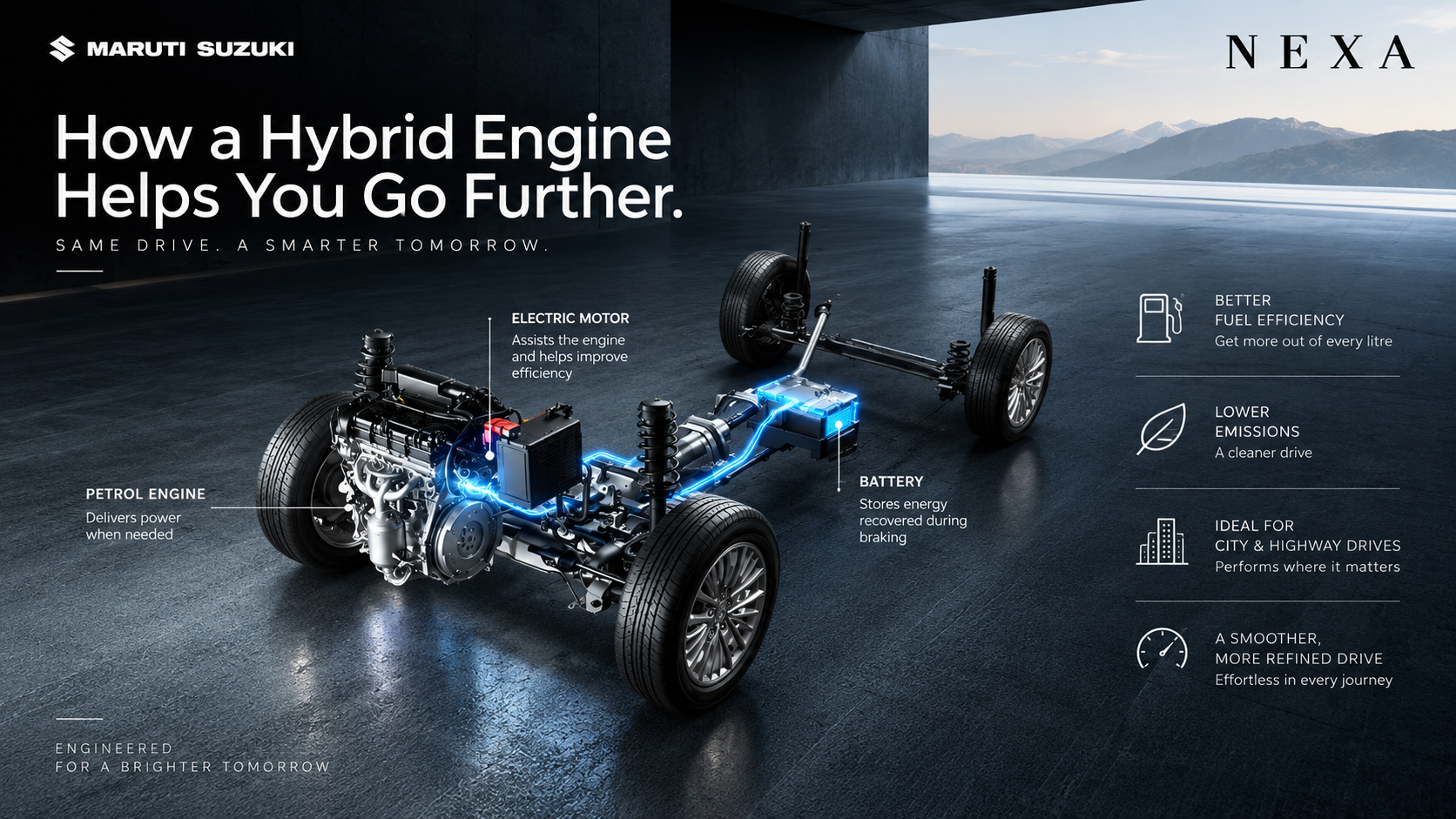
If you've come across the terms Smart Hybrid and Strong Hybrid and assumed they're just two names for the same technology, you'd be wrong. They sound similar, they both sit under the broad umbrella of "hybrid," and they both promise better fuel efficiency, but the way they actually work, and what they let a car do, is genuinely different.
One helps your petrol engine work a little less hard. The other lets the car run on electric power by itself, for real stretches of your drive. Knowing which is which changes how you should think about mileage, price, and what the car feels like on the road.
In this article, we'll break down what each technology actually does, which current car models use them, how they compare side by side, and how to figure out which one fits the way you drive.
What Is a Hybrid Car?
A hybrid car uses two power sources instead of one: a petrol engine and an electric motor, working together to move the car.
The exact balance between the two, how much work the electric motor does, whether it can drive the car on its own, and how big its battery is, is what separates one type of hybrid from another. Maruti Suzuki splits this concept into two distinct technologies: Smart Hybrid and Strong Hybrid.
Smart Hybrid Technology
Smart Hybrid is Maruti Suzuki's mild hybrid technology, where a small electric motor assists the petrol engine but cannot drive the car on its own.
This is Maruti Suzuki's branded name for what the industry generally calls a mild hybrid. It traces back to SHVS (Smart Hybrid Vehicle by Suzuki), which the company first introduced in India in 2015, and the same underlying idea now powers the Smart Hybrid systems across the current lineup.
At its core, a Smart Hybrid system pairs the petrol engine with an Integrated Starter Generator (ISG) and a supporting battery. The ISG does two jobs:
1. During braking and deceleration, it recovers energy that would otherwise be lost as heat and stores it in the battery
2. During acceleration and idle restart, it uses that stored energy to assist the engine, smoothing out the load on the motor and cutting down on fuel burnt in stop-start traffic
What a Smart Hybrid system cannot do is move the car on electric power alone. The electric motor here is an assistant, not an alternative power source. There is no separate drive mode where the engine switches off and the car glides forward on battery power.
You'll find Smart Hybrid technology on these current models:
1. Fronx, with Smart Hybrid Technology, on its 1.0L Turbo Boosterjet engine.
2. XL6, using a 1.5L K15C Smart Hybrid setup built around the same ISG philosophy
3. Grand Vitara, using the same 1.5L K15C Smart Hybrid setup as the XL6, available across its petrol variants including the ALLGRIP Select trim
Because the hardware addition is relatively light (a starter generator and a modest battery, rather than a full second powertrain), Smart Hybrid models cost close to what a conventional petrol variant would, while still returning a meaningful mileage improvement over a non-hybrid setup.
Strong Hybrid Technology
Strong Hybrid is full hybrid technology, where the car can run on electric power alone for short stretches, in addition to using the petrol engine or a combination of both.
This is Maruti Suzuki's branded name for what the industry generally calls a full hybrid or self-charging hybrid. It works on a fundamentally different principle than Smart Hybrid. Instead of one electric motor assisting one engine, a Strong Hybrid system combines:
1. A petrol engine
2. A more powerful electric motor
3. A larger lithium-ion battery
4. A power control unit (that decides, moment to moment, which power source should drive the wheels)
This is what makes the "strong" part of the name accurate. A Strong Hybrid car can genuinely move on electric power alone for short stretches, typically in slow city traffic or at the start of a journey, before the petrol engine kicks in. In everyday driving, the system constantly switches between pure electric, pure petrol, and combined power, depending on load and speed. All of this happens through an e-CVT (a set of planetary gears connecting the engine, motor, and generator), rather than a conventional automatic gearbox, so there are no gear shift shunts to feel.
You'll find Strong Hybrid technology on these current models:
1. Grand Vitara, pairing a 1.5L petrol engine with an electric motor for a combined output of around 115.56 PS, returning up to 27.97 km/l through its e-CVT. Strong Hybrid trims start at ₹16.68 lakh (ex-showroom)
2. Invicto, which takes the technology furthest with a 2.0L Intelligent Electric Hybrid system rated at a combined 188.9 PS, including a dedicated EV-only drive mode and 22.16 km/l mileage.
Note: All prices mentioned in this article are ex-showroom for Delhi, as on 20 September 2026, and are subject to change. Prices may also vary in other cities. Please check with your nearest dealer for current, location-specific pricing.
Smart Hybrid vs Strong Hybrid at a Glance
#heading
- Factor
- Smart Hybrid (Mild Hybrid)
- Strong Hybrid (Full Hybrid)
#row
- Can it drive on electric power alone?
- No, the motor only assists the engine
- Yes, for short stretches at low speed
#row
- Core hardware
- Integrated Starter Generator (ISG) + small battery
- Petrol engine + electric motor + larger battery + e-CVT
#row
- Typical efficiency gain
- Moderate improvement over a standard petrol engine
- Significantly higher, often 25 to 30 percent more than the equivalent petrol variant
#row
- Starting price impact
- Close to standard petrol pricing
- Noticeable premium, reflecting the added motor, battery, and e-CVT
Which One Should You Choose
The right choice comes down to how and where you drive, more than which technology sounds more advanced.
1. If most of your driving is short city trips or daily stop-start commuting: A Strong Hybrid makes the biggest real-world difference, since that is exactly the driving pattern where its electric-only mode gets used the most. Crawling traffic and short errands are where a Strong Hybrid saves the most fuel compared with a petrol or Smart Hybrid equivalent.
2. If you drive a mix of city and highway, and want better efficiency without a large price jump: A Smart Hybrid gives you a genuine mileage improvement over a standard petrol engine, at a price much closer to the base variant. It is the more budget-conscious way to get some hybrid benefit.
3. If you want the lowest running cost and don't mind paying more upfront: Strong Hybrid variants deliver the best fuel efficiency figures in their respective model lines, and that gap widens the more you drive in the city. Over a few years of ownership, the higher purchase price can be offset by fuel savings, particularly for high-mileage drivers.
4. If you're comparing these to other electrification options: Smart Hybrid and Strong Hybrid both still run on petrol as their primary fuel and never need to be plugged in. If you're looking for a car that runs purely on electricity with no petrol engine at all, that is a different category altogether, covered by Maruti Suzuki's electric vehicle, the e VITARA.
A Brief History of Hybrid Technology at Maruti Suzuki
Maruti Suzuki's hybrid journey began in September 2015, with the launch of the Ciaz SHVS, India's first Smart Hybrid Vehicle. Built on the Integrated Starter Generator concept, it was followed a month later by the Ertiga Diesel SHVS. Both cars used the technology to recover braking energy and assist the engine during acceleration and idle restart, and both quickly became mileage leaders in their segments.
Over the next several years, Smart Hybrid technology expanded to more of Maruti Suzuki's lineup, eventually reaching the Fronx, XL6, and Grand Vitara, becoming a standard part of how the company builds efficiency into its petrol engines rather than a standalone feature reserved for a couple of models.
Strong Hybrid technology arrived later, marking a bigger technical leap. It debuted in India with the Grand Vitara, giving Maruti Suzuki its first full hybrid capable of genuine electric-only driving. The Invicto followed, bringing the same full hybrid philosophy to a three-row MPV, complete with a dedicated EV-only drive mode. The Victoris extended the lineup further, running its own Strong Hybrid variant on a dedicated engine tuned specifically for hybrid use.
Today, the two technologies sit side by side across Maruti Suzuki's range, giving buyers a genuine choice between a lower-cost efficiency boost and a full hybrid setup built for maximum fuel savings.
Conclusion
Smart Hybrid and Strong Hybrid represent two different points on the same journey toward greater efficiency. Smart Hybrid gives you a meaningful improvement over a standard petrol engine, without changing how the car drives or costing much more to buy. Strong Hybrid goes further, letting the car run on electric power alone for real stretches of your drive, at a price that reflects the extra technology involved. Neither one needs to be plugged in, and both keep petrol as the primary fuel, which makes them an easy way to step into hybrid motoring without changing your daily routine.
Frequently Asked Questions
1. Is Strong Hybrid the same as a plug-in hybrid?
No. A Strong Hybrid is a self-charging hybrid. Its battery is charged entirely through regenerative braking and the petrol engine, and it never needs to be plugged into an external charger. A plug-in hybrid, by contrast, has a larger battery that is charged from an external power source and typically offers a longer pure-electric range.
2. Which one is more fuel efficient?
Strong Hybrid models consistently return higher ARAI mileage figures than their Smart Hybrid or petrol counterparts, since they can run on electric power alone for part of the drive. Smart Hybrid still improves on standard petrol efficiency, just by a smaller margin.
3. Do I need to do anything differently to maintain a Strong Hybrid car?
Strong Hybrid vehicles are serviced through the same service network as any other Maruti Suzuki car. The hybrid battery and motor are covered under warranty, and day-to-day maintenance, such as oil changes and filters, follows a similar schedule to a petrol variant.
4. Can I convert my existing car to a Strong Hybrid?
No. Strong Hybrid is a factory-built system that is integrated into the car's engine, transmission, and battery layout from the ground up. It is not available as an aftermarket upgrade or retrofit.
5. Will Smart Hybrid be replaced by Strong Hybrid across the lineup?
Both technologies currently serve different needs. Smart Hybrid remains a practical, lower-cost way to improve efficiency, while Strong Hybrid is positioned for buyers who want the biggest efficiency gains and are willing to pay for the added hardware. Maruti Suzuki continues to expand both technologies across new models.